Posts

Image
Production possibility curve (PPC): • PPC represents all possible combination of two products the can be produced with the give amount of input • PPC is also known as opportunity curve because it represents all production possibilities or opportunities available with limited resources • It is called iso-resource curve or iso-factor curve because each output combination in this has the same resource requirement • The amount of land used to produce Maize (Y2) depends upon the amount of land used to produce wheat (Y1). • Therefore, Y1=f (Y2).The allocation of land resource between the two products and the output from different doses of land input are presented below: • Input=5 acres of land As evident from above data, if all 5 acres of land are used in the production of y2 we obtain 60 quintals of y2 and do not get any y1. On other hand, If all the five acres of land are used in the production of y1 we can obtain 30 quintals of y1 and do not get any y2. But these ar...
Product-product relationship • Product-product relationship deals with resource allocation among competing enterprises. • The goal of product-product relationship is profit maximization. • Under product-product relationship, inputs are kept constant while products (outputs) are varied. • This relationship guides the producer in deciding ‘what to produce’? • This relationship is explained by principle of product substitution and law of equimarginal returns . • The relationship is concerned with the determination of optimum combination of products. • The choice indicators are Substitution ratio and price ratio. • Algebraically it is expressed as: Y1=f (y2, y3… yn ).

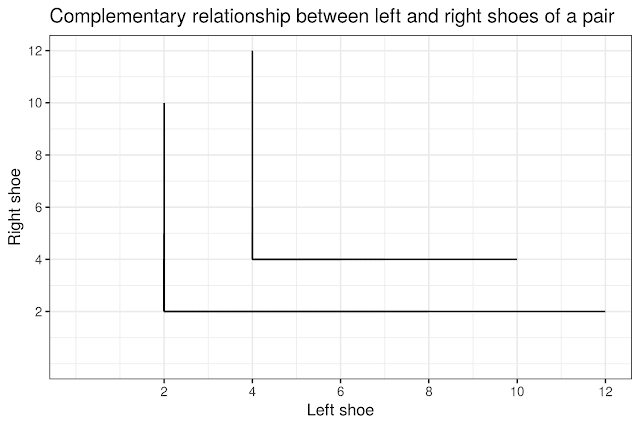
Why the indifference curves of complementary goods right angled ?

Image
Why the indifference curves of complementary goods right angled ? Complementary goods means two goods that have their utility (use) together and if separated they have no utility at all! Take an example of pair of shoes. When they are together (right and left shoes) they have utility but if any one of them is lost, the remaining has no use at all. This was all about complementary goods. Let's check this complementary relationship.  Suppose we have, Left leg shoe (x) Right leg shoe (y) Utility 2                              2                          200 Though the utility cannot be measured cardinally we are supposing it here. In above example I have 2 pair of right leg and left leg shoe and from using them I am getting utility of 200.  If I increase left leg shoe by one,  Left leg shoe (x) Right...
Types of market (On the basis of Competition): A. Perfect and pure competition market Pure competition is said to exist in a market where (a) there is a large number of buyers and sellers (b) products are homogeneous and (c) there is freedom of entry and exit of buyers and sellers.  Characteristics of perfect competition market: 1. Large number of small unorganized sellers and buyers; The industry include large no. of firms (and buyers) , each individual firms supplies only small part of the total quantity offered in the market. Under these conditions each firm alone cannot affect the price in the market by changing its output. Purchasing more or less, large buyers (but unorganized) could not affect in price. 2. Product homogeneity: All the sellers in the market have a perfectly similar product to offer. Product are perfectly substitute for one another: their cross elasticity of the demand is infinite. 3. Free entry and exit of firms: No barrier to entry or exit ...
What is price elasticity of supply? Price elasticity of supply is a measure of the degree of change in the supplied amount of commodity in response to the change in the commodity’s price. In simple words, it can be defined as the rate of change in supply in response to a price change. It is denoted as P or Es. Methods for Measuring Price Elasticity of Supply Basically, price elasticity of supply can be measured by two methods. These methods are Mathematical method/ Percentage method,  Geometric method, Mathematical method/ Percentage Method Percentage method or proportionate method is the commonly used method of measuring price elasticity of supply.  Price elasticity of Supply= Proportion Change in quantity supplied / Proportion change in price of commodity Price elasticity of Supply= %Change in quantity supplied /%change in price of commodity
Image
Supply:   Supply means the various amounts of the commodity, other things remaining constant, the sellers are willing and able to sell at different prices at any moment of time or during any one period of time. In other words of prof. Bach, “Supply is a schedule of amounts that will be offered for sale at different prices during any given time period, other factor remaining unchanged.” The amount of commodity which sellers are willing to sell depends upon a number of factors like price of that commodity, prices of factors of production, state of technology, supply of co-operant factors etc. But for our purpose, supply is taken as function of price alone, all other factors remaining the same. The law of supply states that the quantity of a good offered or willing to offer by the producers/owners for sale increase with the increase in market price of the good and fall if the market price decreases, all other things remaining unchanged. The law of supply establishes a direct re...